
If you operate an industrial unit or warehouse in Halifax, your security requirements are very different from a typical shop or office. Large open spaces, high-value stock and limited out-of-hours presence all increase risk. This leads to a key question: what is the best way to secure a warehouse or industrial unit with a burglar alarm system?
The answer lies in robust, layered commercial security design, built specifically for larger premises.
Why are warehouses and industrial units higher risk?
Industrial environments often present multiple vulnerabilities:
- Large perimeter areas with multiple entry points
- Roller shutter doors and loading bays
- Limited overnight staffing
- High-value or bulk stock
In Bowler (Halifax), where industrial estates can be quieter outside working hours, this makes effective alarm systems essential.
What type of burglar alarm is best for warehouses?
For industrial premises, the best option is a graded commercial alarm system designed for:
- Large coverage areas
- Reliable detection across open spaces
- Integration with other security systems
These systems are typically more advanced than domestic setups and must be carefully configured.
How should a warehouse alarm system be designed?
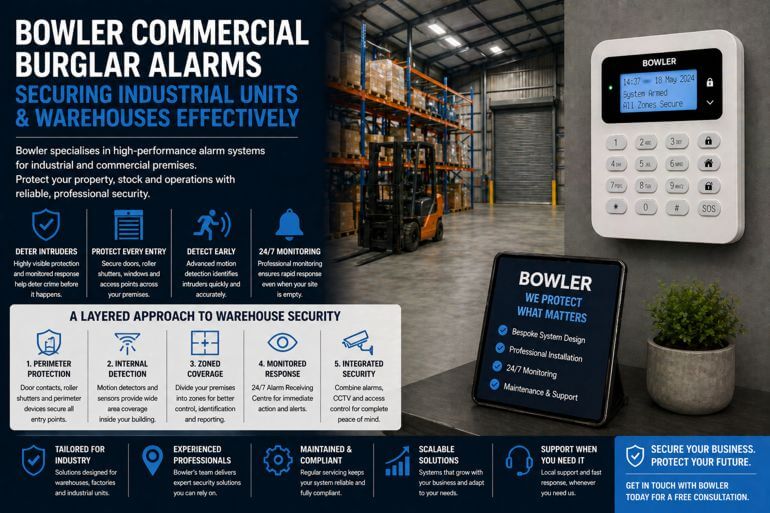
A warehouse alarm system should follow a layered approach:
1. Perimeter protection
This is the first line of defence.
Includes:
- Door contacts on all entry points
- Protection for roller shutters and loading doors
- Window or access point monitoring
This ensures that any attempt to enter the building is detected immediately.
2. Internal detection
Once inside, movement must be detected quickly.
This is achieved using:
- Motion detectors covering open floor areas
- Sensors positioned to cover key routes and aisles
In large Bowler units, correct positioning is critical to avoid blind spots.
3. Zoning for large spaces
Warehouses should be divided into zones, allowing:
- Clear identification of alarm activations
- Independent control of different areas
- Reduced disruption when accessing parts of the building
4. Monitored alarm systems
For industrial premises, monitoring is strongly recommended.
This ensures:
- 24/7 response via an Alarm Receiving Centre
- Immediate action when the alarm is triggered
- Protection even when the site is empty
5. Integration with CCTV
Combining alarms with CCTV provides:
- Visual verification of activations
- Faster and more informed responses
- Improved overall security
This is particularly valuable in large spaces where identifying the source of an alarm quickly is essential.
What about access control?
Many industrial premises also benefit from access control systems.
These allow:
- Controlled staff entry
- Tracking of access events
- Reduced risk of unauthorised access
When integrated with the alarm system, this creates a more comprehensive security setup.
How do you reduce false alarms in large buildings?
False alarms can be disruptive, particularly in monitored systems.
To reduce risk:
- Use appropriate sensors for large spaces
- Ensure correct positioning and calibration
- Maintain the system regularly
Professional design is essential to get this right.
Is maintenance important for warehouses?
Yes — even more so than smaller properties.
Regular servicing ensures:
- Sensors remain effective in dusty or industrial environments
- Communication systems remain reliable
- The system continues to meet compliance requirements
Final Answer: How do you secure a warehouse in Bowler (Halifax)?
The most effective solution is a professionally designed, layered burglar alarm system that includes:
- Perimeter protection
- Internal detection
- Zoned coverage
- Monitoring for out-of-hours response
- Integration with CCTV
For industrial units in Halifax, this approach provides reliable, scalable and effective protection, ensuring that your premises, stock and operations remain secure.
:%20How%20to%20Secure%20Industrial%20Units%20and%20Warehouses%20Effectively)