
CCTV Camera Angles –
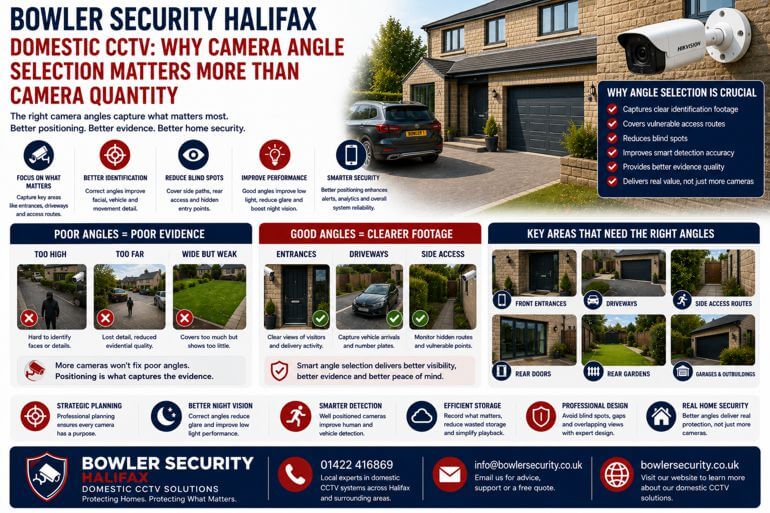
Many homeowners assume that improving home security simply means installing more CCTV cameras. However, modern domestic CCTV design increasingly focuses on something far more important — camera angle selection.
For many properties in Halifax, the effectiveness of a CCTV system depends less on the number of cameras installed and more on whether the cameras are positioned correctly to capture:
- useful identification footage
- vulnerable access routes
- and meaningful activity
Poorly positioned systems with excessive cameras may still fail to provide valuable evidence when incidents occur.
More Cameras Can Create Unnecessary Complexity
Adding additional cameras without proper planning may lead to:
- overlapping useless views
- wasted storage
- excessive notifications
- and confusing playback
A smaller number of well-positioned cameras often provides:
- clearer coverage
- simpler management
- and better evidential quality
Camera Angles Affect Identification Quality
A camera mounted too high or too far away may only capture:
- the tops of heads
- distant movement
- or unclear facial detail
Good angle selection helps improve:
- facial visibility
- vehicle identification
- and movement tracking
particularly around:
- entrances
- driveways
- and pathways
Side Access Routes Are Often Overlooked
Many domestic properties contain:
- side gates
- rear paths
- detached garages
- or hidden access areas
These locations may become vulnerable if cameras focus only on:
- front driveways
- or obvious entrance points
Careful angle planning helps improve perimeter awareness.
Wide Views Can Reduce Useful Detail
Some homeowners attempt to cover very large areas with:
- ultra-wide camera views
- or excessively high mounting positions
Although this may appear to improve visibility, it can reduce:
- facial detail
- evidential clarity
- and overall usefulness
Modern CCTV systems work best when coverage focuses on:
- important movement areas
- access routes
- and key activity zones
Lighting Conditions Influence Camera Performance
Camera angles should also consider:
- sunlight direction
- reflections
- shadows
- and night-time lighting
Poor positioning can create:
- glare
- silhouetting
- or reduced visibility
particularly around:
- garage doors
- glass entrances
- or driveway lighting
Driveway Monitoring Requires Balance
Effective driveway coverage should ideally capture:
- approaching visitors
- vehicle arrivals
- and movement near parked vehicles
without positioning cameras so far away that detail becomes unusable.
Modern Analytics Depend on Good Positioning
Features such as:
- human detection
- vehicle recognition
- and smart alerts
perform far more reliably when cameras are:
- correctly angled
- properly focused
- and positioned around meaningful activity areas
Rear Garden Coverage Needs Careful Planning
Rear gardens often contain:
- fences
- outbuildings
- patio doors
- and lower visibility areas
Camera placement should prioritise:
- likely access routes
- vulnerable entry points
- and practical identification zones
rather than simply covering open space.
Professional CCTV Design Helps Avoid Blind Spots
Incorrect camera angles may unintentionally create:
- hidden areas
- coverage gaps
- or obstructed views
Professional planning helps ensure:
- consistent visibility
- balanced coverage
- and effective monitoring throughout the property
Good CCTV Is About Useful Coverage
For homeowners in Halifax, domestic CCTV should focus on:
- meaningful evidence
- practical visibility
- and reliable security awareness
rather than simply increasing camera numbers.
Well-positioned CCTV systems help provide:
- stronger identification footage
- improved perimeter monitoring
- smarter alert performance
- and better long-term home security value
As modern CCTV technology advances, intelligent camera placement is becoming one of the most important parts of effective domestic security design.
Frequently Asked Questions
Is more CCTV always better?
No. Poorly positioned cameras may still fail to provide useful footage even in larger systems.
Why do camera angles matter?
Correct angles improve facial visibility, reduce blind spots and increase evidential quality.
Can camera positioning improve smart alerts?
Yes. Proper positioning improves the accuracy of human and vehicle detection systems.
