
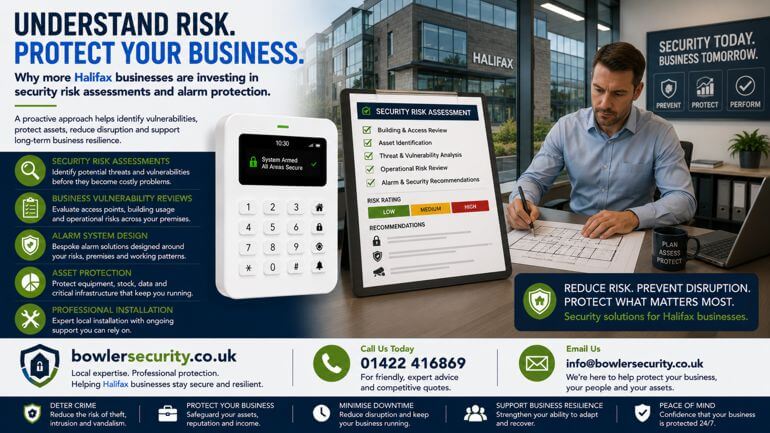
Security Risk Assessments –
Security risk assessments have traditionally been associated with larger organisations, corporate facilities and heavily regulated industries. However, across Halifax, an increasing number of small and medium-sized businesses are recognising the value of taking a more structured approach to understanding and managing security risks.
Many business owners understandably focus on sales, staffing, customer service and day-to-day operations. Security often receives attention only after an incident occurs. Unfortunately, by the time a burglary, break-in or security breach has taken place, the business is already dealing with the financial and operational consequences.
A security risk assessment provides an opportunity to identify vulnerabilities before they become problems. Rather than simply installing a burglar alarm and hoping for the best, businesses can review how their premises are used, where potential weaknesses exist and which security measures are likely to provide the greatest benefit.
One of the most common findings during security reviews is that businesses frequently underestimate the value of their assets. Whilst owners may focus on stock or equipment, they often overlook the cumulative value of computers, tools, documentation, specialist machinery and infrastructure. In many cases, replacing these items would be both expensive and disruptive.
Access points are another area that deserves careful consideration. Front entrances naturally receive attention, but rear doors, fire exits, delivery entrances and service access routes can sometimes present greater risks. Criminals often look for the least visible and least protected route into a building rather than attempting access through the most obvious entrance.
Many Halifax businesses operate from premises that have evolved over time. Offices have been reconfigured, storage areas expanded and operational requirements changed. Security arrangements that were appropriate several years ago may no longer reflect the way the building is used today.
A structured risk assessment also considers occupancy patterns. A busy office during working hours may become completely unoccupied overnight. Retail premises may experience high customer footfall during the day but remain vulnerable outside trading hours. Understanding these patterns helps inform more effective alarm system design.
Business continuity is a major factor that is often overlooked. Security is not simply about preventing theft. It is about ensuring that the organisation can continue operating if an incident occurs. A break-in affecting critical equipment or essential infrastructure can have consequences far beyond the value of stolen items.
Small businesses can be particularly vulnerable because they often have fewer resources available to absorb unexpected losses. A security incident that might represent an inconvenience for a large organisation could become a significant operational challenge for a smaller company.
Modern burglar alarm systems play an important role within a broader risk management strategy. However, the effectiveness of any alarm system depends upon it being designed around the specific risks associated with the premises. A risk assessment helps ensure protection is targeted where it is needed most.
Insurance requirements may also influence security planning. Insurers increasingly expect businesses to demonstrate a proactive approach to managing risk. Documented security reviews and professionally installed alarm systems can help support this objective.
Employee awareness should not be overlooked. Even the most advanced alarm system can be undermined by poor procedures or inconsistent security practices. Risk assessments often highlight opportunities to improve operational security through simple procedural changes.
As businesses grow, relocate or diversify, security requirements naturally evolve. Regular reviews help ensure protection remains aligned with operational realities rather than historical assumptions.
Many security vulnerabilities can be addressed relatively easily once they have been identified. The challenge is recognising those vulnerabilities before they are exploited. This is where a structured assessment process delivers significant value.
For Halifax businesses, effective security starts with understanding risk rather than simply purchasing equipment. A professionally designed burglar alarm system remains one of the most effective security measures available, but it delivers the greatest value when supported by a clear understanding of the threats facing the organisation.
By taking a proactive approach to security risk assessments, businesses can improve resilience, reduce vulnerabilities and create a safer environment for employees, customers and assets. Ultimately, the goal is not merely to respond to incidents but to prevent them from occurring in the first place.
